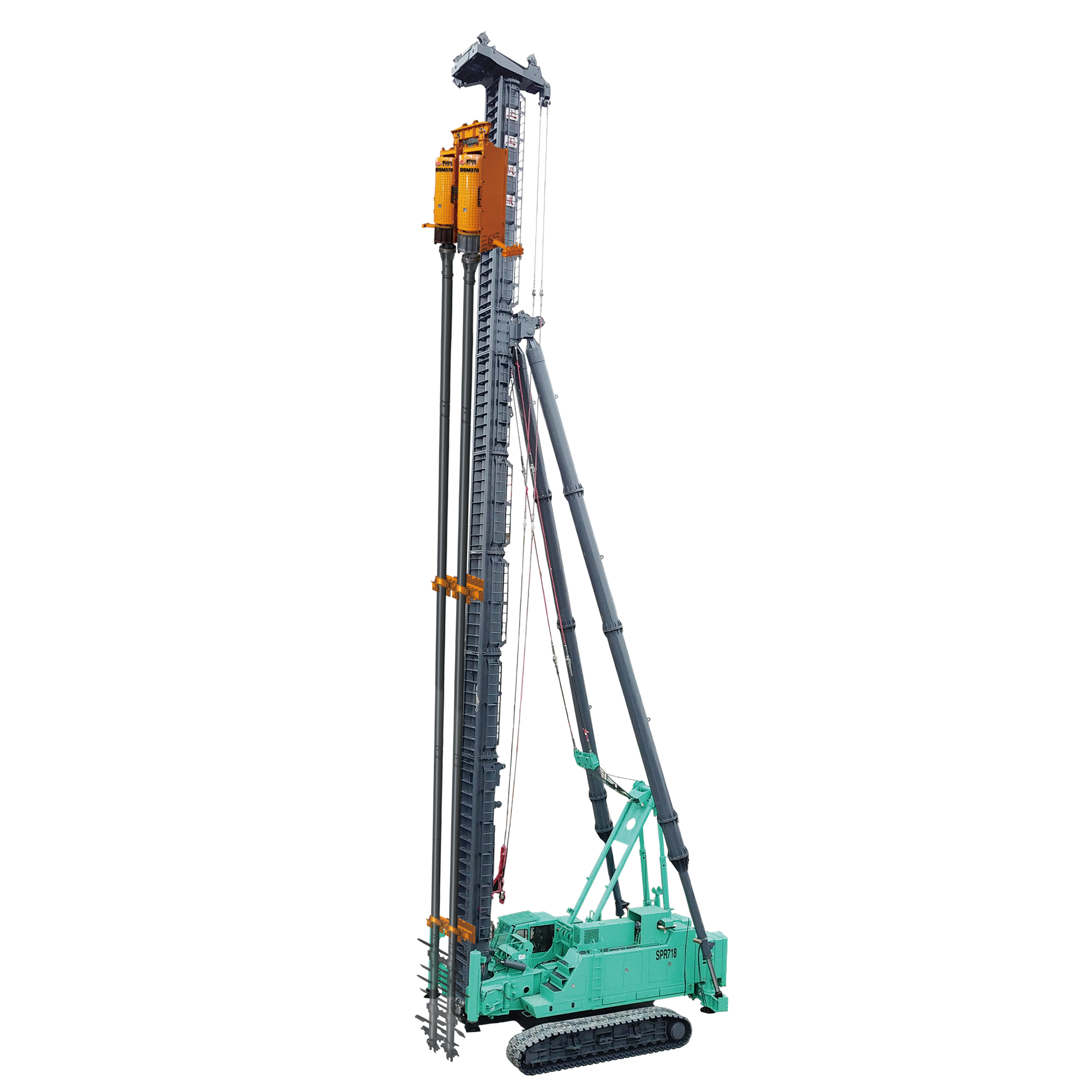
The SEMW DSM Series Deep Soil Mixing Equipment is designed for in-situ soft ground improvement using twin-shaft drilling and cement slurry mixing technology. It combines mechanical soil mixing, controlled grout delivery and construction data monitoring to support foundation reinforcement in marine, infrastructure and underground engineering projects.
Available in four models—DSM180, DSM220, DSM370 and DSM500—the series offers maximum drilling diameters from Ø800 mm to Ø1800 mm, with multiple shaft-spacing and power configurations for different ground treatment requirements.
The SEMW DSM Series is engineered for in-situ improvement of soft ground through deep soil mixing. A dual-shaft drilling and mixing system introduces cement slurry into the soil and mechanically blends the materials to form treated soil columns for foundation reinforcement.
Four configurations—DSM180, DSM220, DSM370 and DSM500—allow foundation contractors to match drilling diameter, depth, rotary torque and shaft spacing to the design and construction environment.
4 ModelsDSM180–DSM500
Ø800–1800Nominal max diameters (mm)
Up to 32 mSpecified drilling depth
2 ShaftsDual-shaft system
SEMW deep soil mixing equipment configuration with twin drive heads.
Engineered ground treatment
Key Design Features
Dual-Shaft Mixing
Two rotating shafts and mixing blades work through the soil while cement slurry is introduced, improving the distribution of binder within the target treatment zone. The drilling tool configuration supports coordinated penetration and mixing.
Adaptable Shaft Spacing
Model-specific drill-pipe center distances give engineers options for pile layout and treatment geometry. The DSM370 is available with 1050, 1150, 1250 and 1450 mm center-distance arrangements.
Controlled Slurry Injection
The three-channel grouting rotary joint combines slurry and gas pathways. Automatic mixing, delivery and monitoring help control slurry supply alongside drilling and lifting operations.
Compare drilling geometry and power requirements to identify a suitable configuration for the planned soil improvement works.
Parameter
DSM180
DSM220
DSM370
DSM500
Maximum single-shaft drilling diameter
Ø800 mm (customizable)
Ø1300 mm
Ø1500 mm
Ø1800 mm
Drilling depth
32 m
18 m
30 m
30 m
Number of drill shafts
2
2
2
2
Drill-pipe center distance
1400–2400 mm (200 mm increments)
1000 / 1100 / 1200 mm
1050 / 1150 / 1250 / 1450 mm
1250 / 1500 / 1700 mm
Rated motor power
90 × 2 kW
110 × 2 kW
185 × 2 kW
250 × 2 kW
Maximum drill-pipe torque
45 kN·m (up to 68 kN·m configuration)
82 kN·m
120 kN·m
180 kN·m (up to 195 kN·m configuration)
Drill-pipe rotation speed
19–38 r/min
19–45 r/min
15–45 r/min
13–39 r/min
Approximate equipment weight
27 t
30 t
35 t
37 t
Working configuration, ground conditions and the complete rig combination should be reviewed before final equipment selection.
DSM Series model comparison and technical parameters.Dimensions and drill-string configurations for DSM models.
Mixing technology
Dual-Shaft Auger, Grouting Joint and Drill Bit Design
Modular Auger and Drive Arrangement
The auger drive assembly uses separate lifting frames, a backplane and lifting blocks. The system can be used as a single-shaft arrangement or combined into a dual-shaft mixing configuration, depending on the model and working requirements.
Three-Channel Grouting Rotary Joint
Independent delivery passages support the transfer of cement slurry and gas through the rotating assembly. The upper air inlet and side slurry inlet are designed to connect with the treatment process.
Counter-Rotating Drill Tools
Dual drill pipes and mixing blades support the mixing process. Conical drill-tool geometry and blade arrangements are designed to support drilling and thorough binder-soil blending.
Auger drive, grouting rotary joint and drill bit structural components.
Process visibility
Construction Management and Slurry Control
Construction control, slurry delivery and operating data interface.
The construction management system coordinates drilling operations with slurry preparation, delivery and construction data collection. It provides an integrated view of key construction parameters to support process control.
Rig and Mast Monitoring
Monitor drilling rotation, speed adjustment, current loading, mast inclination and operating status.
Automated Mixing and Injection
Set water–cement ratio and dosing parameters, coordinate slurry pump flow with drilling and lifting speed, and control pipeline flow transitions.
Data Logging and Remote Access
Capture drilling depth, speed, slurry flow rate, pressure and selected machine status data. Recorded data can be reviewed for construction process analysis, including remote visibility through supported mobile or computer interfaces.
Where DSM technology is used
Deep Soil Mixing Applications
Marine and Coastal Foundations
Soft-ground treatment for artificial islands, coastal structures, piers and shoreline works where improved soil behavior is required.
Retaining and Excavation Works
Ground reinforcement for retaining structures, embankment foundations and foundation construction in soft soil conditions.
Infrastructure and Underground Works
Soft ground treatment for selected tunnel approaches and civil engineering projects, subject to geotechnical design and site access.
Application suitability depends on ground investigation, mixing design, target strength, binder specification and on-site quality verification.
Real construction environments
SEMW Equipment in the Field
Field photography highlights crawler-mounted foundations equipment, high mast structures and mixing-head arrangements used in ground improvement work.
SEMW deep soil mixing equipment at a foundation construction site.SEMW deep soil mixing piling rigs working at a construction site under blue sky.SEMW crawler-mounted foundation equipment with orange mixing head at an active construction site.SEMW DSM twin-shaft deep soil mixing equipment on foundation engineering site.Two SEMW deep soil mixing rigs with dual mixing units operating at a construction site.Two deep soil mixing rigs deployed together at a construction site.
Equipment selection
How to Select a DSM Series Configuration
1. Soil and Treatment Objective
Confirm soil strata, groundwater, target strength, permeability and the design purpose of the mixed columns.
2. Column Geometry
Establish pile diameter, center-to-center spacing, depth, overlap geometry and site constraints.
3. Construction System
Assess rotary torque, power supply, cement slurry facilities, rig configuration, quality control and site logistics.
Frequently asked questions
DSM Series FAQ
What is the difference between DSM180, DSM220, DSM370 and DSM500?
The four models differ in maximum drilling diameter, drilling depth, rated motor power, rotary torque and drill-pipe center-distance configurations. The DSM500 has the largest listed maximum drilling diameter and rated motor power, while the DSM180 has a specified drilling depth of 32 m.
How does deep soil mixing strengthen soft ground?
The equipment drills into the soil while introducing and mixing cement slurry with the in-situ ground. The cement binder hardens and reacts with soil components to form improved ground. Performance depends on mix design, geology, construction control and testing.
Can shaft spacing be adjusted?
Yes. The available center distances vary by model. DSM370 supports 1050, 1150, 1250 and 1450 mm configurations; other models have their own specified spacing options.
Which information is needed for equipment selection?
Provide the geotechnical report, target treatment depth, pile diameter and spacing, binder mix requirements, performance criteria, access constraints and available site utilities so the equipment configuration can be reviewed.
Discuss Your Deep Soil Mixing Project with SEMW
SEMW provides deep foundation equipment and engineering-oriented product support. Share your foundation design, treatment depth, target column geometry and ground conditions to discuss a suitable DSM Series configuration.

 한국어
 中文